What is agent looping — and why one pass is never enough
By Max Zwisler · Published May 28, 2026 · 2 min read
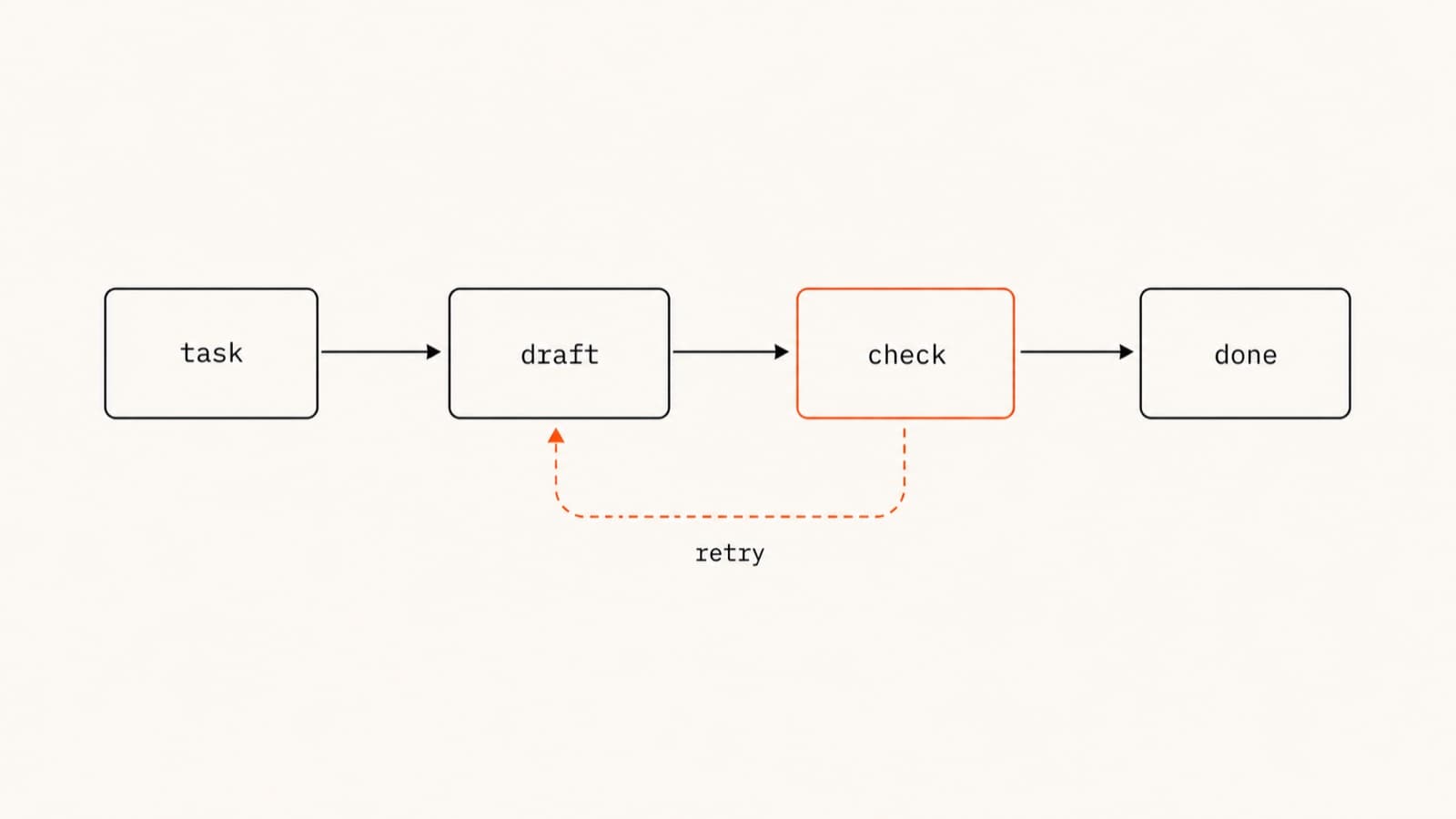
Ask a model to write a report and you get a draft. Run the same task in a loop — generate, check, revise, check again — and you get something you can actually ship. That loop is the unit of work we build everything on.

The anatomy of a loop
A working agent loop has four parts:
- Task in. A concrete instruction with context attached: the goal, the format, the constraints, the source data.
- Attempt. The agent does the work — drafts the e-mail, builds the report, writes the SQL.
- Check. A separate step verifies the attempt against explicit criteria. Does the number in the summary match the source table? Does the copy follow the brand rules? Does the query run?
- Route. Pass → deliver. Fail → back to step 2 with the failure attached. After N failures → escalate to a human with the full trail.
The check is the part most teams skip, and it is the part that makes the rest safe. Without it you have a very fast intern with no supervisor. With it you have a system where errors are caught structurally — not when a customer replies to the broken e-mail.
Loops compound
The second property that makes looping interesting: a loop writes back what it learned. The checker rejected a draft because the price list was outdated? The corrected price goes into the company brain, and every future loop reads the right one. Failures stop repeating.
This is the practical difference between "we use AI" and "we run on agents". A chat window forgets every conversation. A loop with memory gets measurably better month over month — the eval pass rate on our own weekly reporting agent went from 71% to 96% in eight weeks, with no model upgrade. Same model, better memory, tighter checks.
Where to start
Pick one recurring task with a clear definition of done — weekly reporting is ideal. Write the checks first: what would a careful human verify before sending this? Then build the smallest loop that passes those checks. One loop in production beats a platform on a roadmap.
Frequently asked questions
Instead of a single answer, an agent runs its output through a checking step and corrects before the result moves on. One pass produces a draft; the loop produces a result.
They work in a loop of goal, plan, act and check, drawing on your tools and a shared memory — instead of just answering a single prompt.
Related
Operator Notes.
How we run a company on agents. One e-mail when we publish — no drip sequence, no sales follow-up.